A clear shift is happening in commercial real estate: any sustainability initiative now has to survive ROI scrutiny, or it will die in the drawer.
This has long been obvious for things like equipment upgrades, retrofits, and solar, and similarly, investments in real time energy monitoring have always been judged based on the ROI they deliver.
But now the scrutiny is coming for everything, even the reporting tools.
A few weeks ago, we ran a survey with sustainability leaders about this. A few conclusions we took away:
- 83% say sustainability no longer moves forward without a clear financial justification or direct return.
- 55% reported that the reporting and data collection process consumes so much time that it prevents project execution.
- 65% believe current reporting platforms consume resources without offering financial return to operations.
- And nearly the same 65% specifically mentioned that reporting platform fees are high and also make it harder to implement other efficiency or decarbonization solutions.
The rules of benchmarking and reporting have changed. What started with automation and then accuracy is now moving toward clear and direct ROI.
Fortunately, utility data is a goldmine, and your reporting platform can pay for itself.
The End of the Free Pass for Benchmarking
Equipment upgrades, building improvements, solar, and other CapEx projects have always been treated as pure investments, and either the business case holds up or the project is dropped.
That’s because these are property level initiatives that have to fit into the investment thesis of the particular asset and fund.
On the other hand, portfolio scale benchmarking has for a long time skated by without having to prove an ROI. After all, it was seen as a bureaucratic necessity and a required cost to meet investor and regulator demands.
But the environment has changed. Between political headwinds, a tighter economic outlook, or whatever the reason, scrutiny on sustainability spend has reached a new level.
Carbon planning is clearly essential, but helping build 10 or 15 year CapEx plans is not the same as delivering ROI today.
In this new paradigm, reporting platforms need to stop being passive data repositories and become active profitability tools.
Even in triple net settings, where owners traditionally have limited control, delivering real financial value becomes the currency required to motivate tenants to share their consumption data.
Let’s talk about a few ways benchmarking and reporting platforms can deliver ROI today.
Energy Procurement
The energy brokerage market is arguably one of the most fragmented in the country. Thousands of small two or three person operations profitably manage a handful of local accounts in a near handcrafted way.
The traditional model is simple: they fix rates, monitor expiration dates in spreadsheets, and call the client when renewal approaches to make sure the contract gets signed.
Fortunately, there is a better way. By using granular data and real time market monitoring, you stop being a hostage to the renewal calendar.
Instead of signing a contract simply because the current one is expiring, you can lock rates at the optimal market moment.
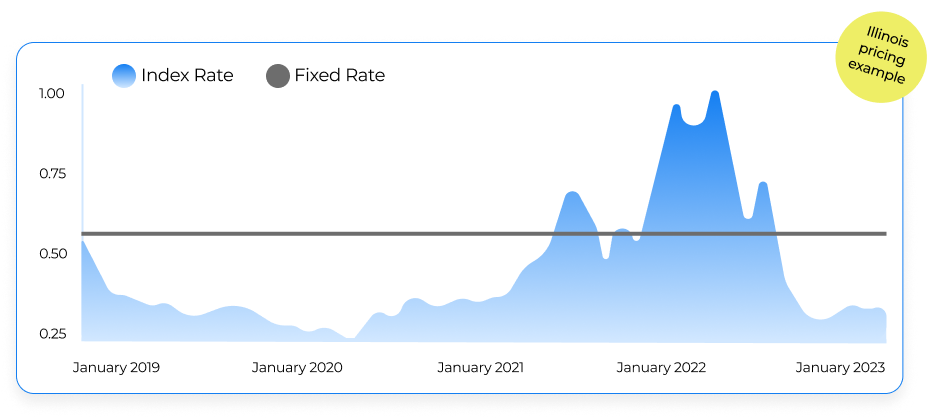
You can also blend fixed and floating rates to get the right balance of savings and risk for your situation.
This shift from reactive procurement to a data driven strategy can represent millions of dollars in savings across a portfolio.
Real example
Enertiv identified a better procurement opportunity for a 900,000 sq ft office building. Through our partnership with Energy CX, which managed the execution of the operation, we were able to deliver $206,718 in annual savings for this single property.

CASE STUDY
How Enertiv improved Energy Star Score from 57 to 75 and created $9.2M in asset value at a 600K SF Class A office tower