Your Decarbonization Plan Is Only as Good as the Data Underneath It


Real estate decarbonization has two problems and most teams are only solving one.
The first is capital. To unlock it, you need fund-level data: total costs, projected savings, emissions reduction at scale. This is where the big reports live: compelling decks and reports, institutional investors, millions of dollars of opportunity.
It's a good story and it's not hard to get people excited about it.
The second is execution. And this is where the story falls apart.
AI Can Probably Tell You Where to Go, But Not What's Already Been Done
For unlocking capital, AI decarbonization tools are exactly the right instrument, and should be part of any modern sustainability reporting platform.
The premise is straightforward: if you can identify and originate projects quickly and at scale, you unlock a category of transition capital that was previously too slow or too expensive to access. Done well, this is genuinely powerful.
The more sophisticated pitch goes further: AI that learns continuously, draws inferences from external and internal data, and identifies projects without requiring a physical presence on site.
The theory is sound on its surface. If a model ingests enough data points, building characteristics, utility history, equipment classes, regional climate data, construction patterns, it should be able to infer what's inside a building with reasonable accuracy.
But inference is not ground truth. And in buildings, the delta between the two is where projects go to die.
A model can infer that a 1987 office tower in Chicago likely has aging air handling units. It cannot know that one of them has been repaired three times in the last two years and the compressor is already failing, that the as-builts don't reflect a renovation done in 2019 and that the equipment scheduled for replacement in the capital plan was already swapped out in kind last month because the operational pressure was immediate and nobody flagged it in time.
That last one is the killer.
Not because it's rare, but because it's routine. There's a patchwork of PDFs from third-party vendors, maintenance tickets living in a CMMS, PM schedules nobody is cross-referencing. When a rooftop unit reaches end of life, it triggers a site assessment, then an engineer of record, another PDF report, and by then the replacement decision has been bundled into a broader capital project with its own business case that can get cancelled for reasons that have nothing to do with sustainability. When that happens, the sustainability goal doesn't go away. The team is still held to it.
So the equipment gets replaced in kind.
Not because anyone decided that was the right call, but because there was stock available, the pressure was immediate, and nobody had the time or the information to make a better decision. The electrification opportunity is gone.
The 20-year plan has a hole in it that no inference engine saw coming.
Building operators are being sent on treasure hunts. Sustainability engineers are piecing together a patchwork of systems trying to answer a question that should have a simple answer: is this unit ready to be replaced or not?
That's not a data science problem, it’s a ground truth problem.
Operational Improvements Can Drive Significant Savings Before Any CapEx
There's another ceiling that doesn't get talked about enough.
AI carbon plans are structurally limited to CapEx projects. That's not a criticism, it's just the reality of what inference can and can't do. A model can estimate what equipment needs to be replaced, but it cannot tell you that the high-efficiency system you installed two years ago is running 24/7 due to a control issue and hasn't delivered a dollar of the savings it was supposed to.
Operational improvements, the kind that come from knowing how a building actually runs, can cut consumption 10 to 30% before a dollar of CapEx is deployed.
Skip that step and you risk sizing your upgrades wrong. You build a decarbonization plan on top of a building that was never optimized, and the math is off from the start.
The honest answer is that real-time monitoring is a project in itself, and not every building has it.
But every CapEx project is an opportunity to build that foundation, and M&V isn’t just a compliance checkbox. It’s how you start actually knowing what’s happening inside the building, which makes every subsequent decision better.
If monitoring is already in place, you have a significant advantage. If it isn't, the next equipment replacement is where you start.
The Foundation Should Be a Living Inventory
The foundation is a current, complete equipment inventory. And building one doesn't have to mean an expensive engineering study or a months-long internal survey campaign that falls apart without constant management pressure.
Enertiv's survey teams move through a building fast, capturing every piece of mechanical equipment on a dedicated app built for the job. AI processes the nameplate photos into structured data: make, model, serial number, install date, efficiency ratings.
The output isn't a PDF. It's a living inventory that reflects what's actually on site, stays current as conditions change, and is accessible to both on-site teams and asset managers.
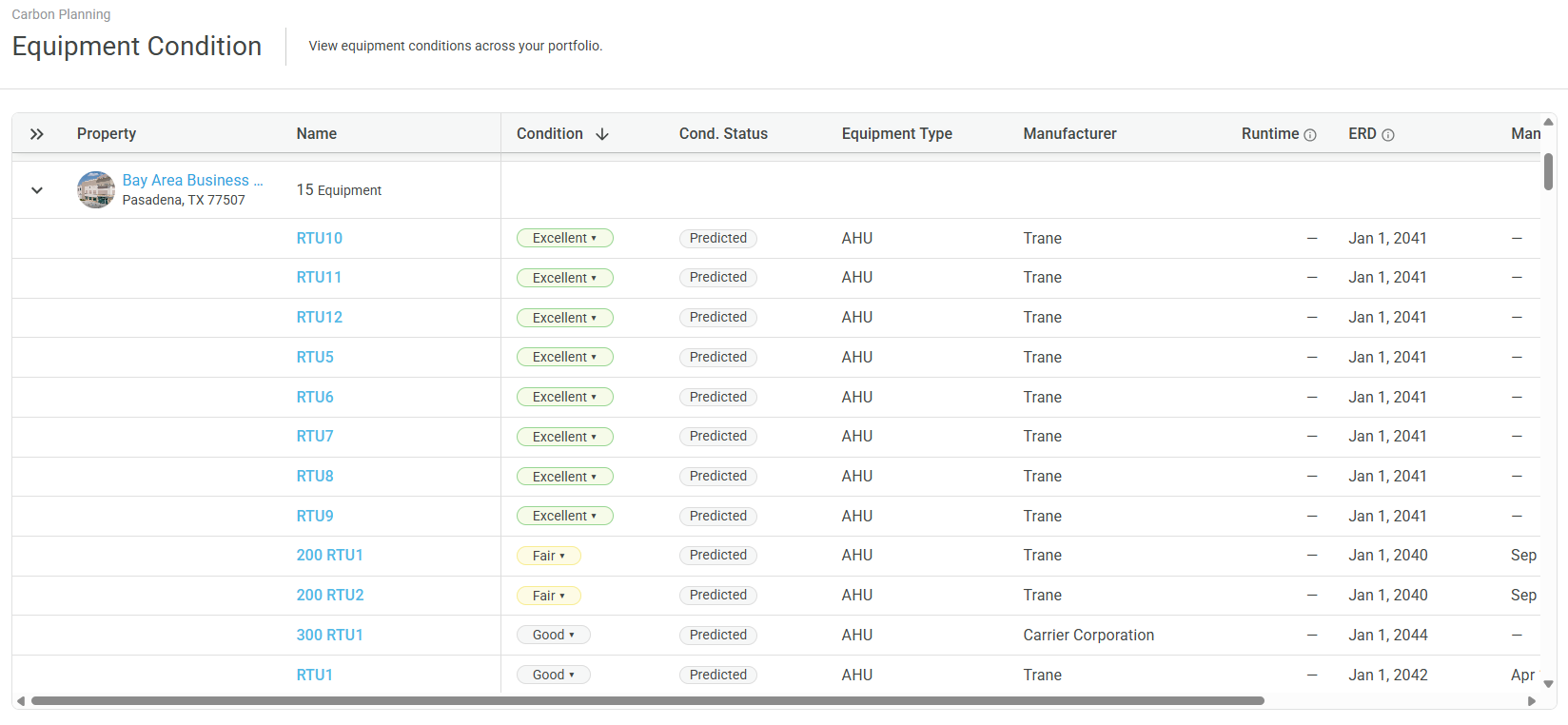
That's the foundation. And here's what it makes possible.
When you combine a current equipment inventory with observed condition data, you can do something no inference engine can: triage. Across one portfolio, we pinpointed 305 pieces of equipment already past their replacement date, cross-referenced against physical condition observed within the last year.
That's not a probability, it’s a list.
305 units that need a low-carbon alternative identified and ready before they fail, because when they do fail, they get replaced in kind. That’s how it always goes when the operational pressure is immediate and the alternative isn’t already lined up.
No AI reasoning from the outside builds that list. It requires knowing what's actually there, when it was installed, and what condition it's in right now.
What Execution Actually Looks Like
The industry keeps perfecting the fund-level story. And that story matters: unlocking capital requires it.
But capital without execution is just a report.
Execution requires knowing what’s actually in the building and when it needs to be replaced. But it also requires knowing what it should be replaced with, not just in kind, but with the right low-carbon alternative given the property’s carbon roadmap and available incentives. And then actually being able to move on it.
That’s the piece pure AI tools can’t touch. The technology may be impressive, but execution isn’t an inference problem.
Here's what that looks like in practice. A replacement recommendation surfaces for a specific unit at a specific property. The asset manager can see what's due, what it should be replaced with, and what utility incentives are available for that upgrade. From there, they can get bids from a network of vetted vendors directly through the platform. The recommendation doesn't sit in a report waiting for someone to act on it, it flows through to a project.
And as that replacement gets executed, it feeds directly into the property's carbon reduction roadmap. Equipment lifecycles, incentive eligibility, and Scope 1 and 2 emissions targets are unified in a single workflow, so every replacement decision is made with the full picture in view.
This is what it looks like to close the gap between strategy and execution. Not just a smarter model, but a connected system that knows what’s in your buildings, keeps that knowledge current, and gives every stakeholder, from asset managers to chief engineers to sustainability teams, what they need to actually get projects done.
The data is there, the AI tooling is maturing fast, and the business case is real.
But none of it moves without execution. And execution starts on site.