
How an Industrial Landlord Flipped the Script From Asking for Utility Bills to Delivering $430K in Tenant Insights
With GRESB and UNPRI deadlines coming up, this real estate investment manager was dealing with a problem common to triple net portfolios: gaps in tenant-controlled utility data.
They had tried everything: direct outreach, consultants, and manual readings tracked in spreadsheets. None of it provided a consistent way to capture data.
"We were spending a lot of time and money sending people out to take pictures of meters. We were getting errors, we had turnover, we were retraining. We were spinning our wheels."
Sustainability & Resilience Lead
After successful deployments with several of their partners and JVs, Enertiv was selected to replace the manual process with a combination of approaches. The experience at one of the assets, with six buildings and 19 tenants, illustrates how the landlord tackled the challenge and delivered quantifiable value to their tenants along the way.
Key Results
- $430K/yr in savings and revenue opportunities identified so far
- 100% electric data coverage through shadow metering + gas captured through the Enertiv mobile app and a QR code system
Matching the Approach to the Asset
To meet the reporting requirements within the landlord's capital budget, Enertiv deployed a tailored combination of its data capture approaches.
- For electric accounts, we deployed non-proprietary shadow meters that capture real-time consumption for each tenant and the building as a whole, without requiring any involvement from property managers or tenants. Because the data is collected in real time rather than monthly, it can also be used to identify operational efficiency measures, cutting energy waste and reducing costs for the tenant.
- For gas, Enertiv implemented its manual reading system, with QR codes installed at each meter and readings captured through a mobile app that catches errors and flags inconsistencies as they're entered. It's a low-cost, scalable way to capture whole-building data without the errors that come with spreadsheets.
- For common area accounts held in the landlord's name, Enertiv integrated directly with the utility portals for automatic ingestion and validation.
All of it is captured and validated, correctly mapped to the right meters, spaces, and tenants, automatically synced to Energy Star Portfolio Manager, and available in the Enertiv platform for one-click reporting exports across multiple frameworks.
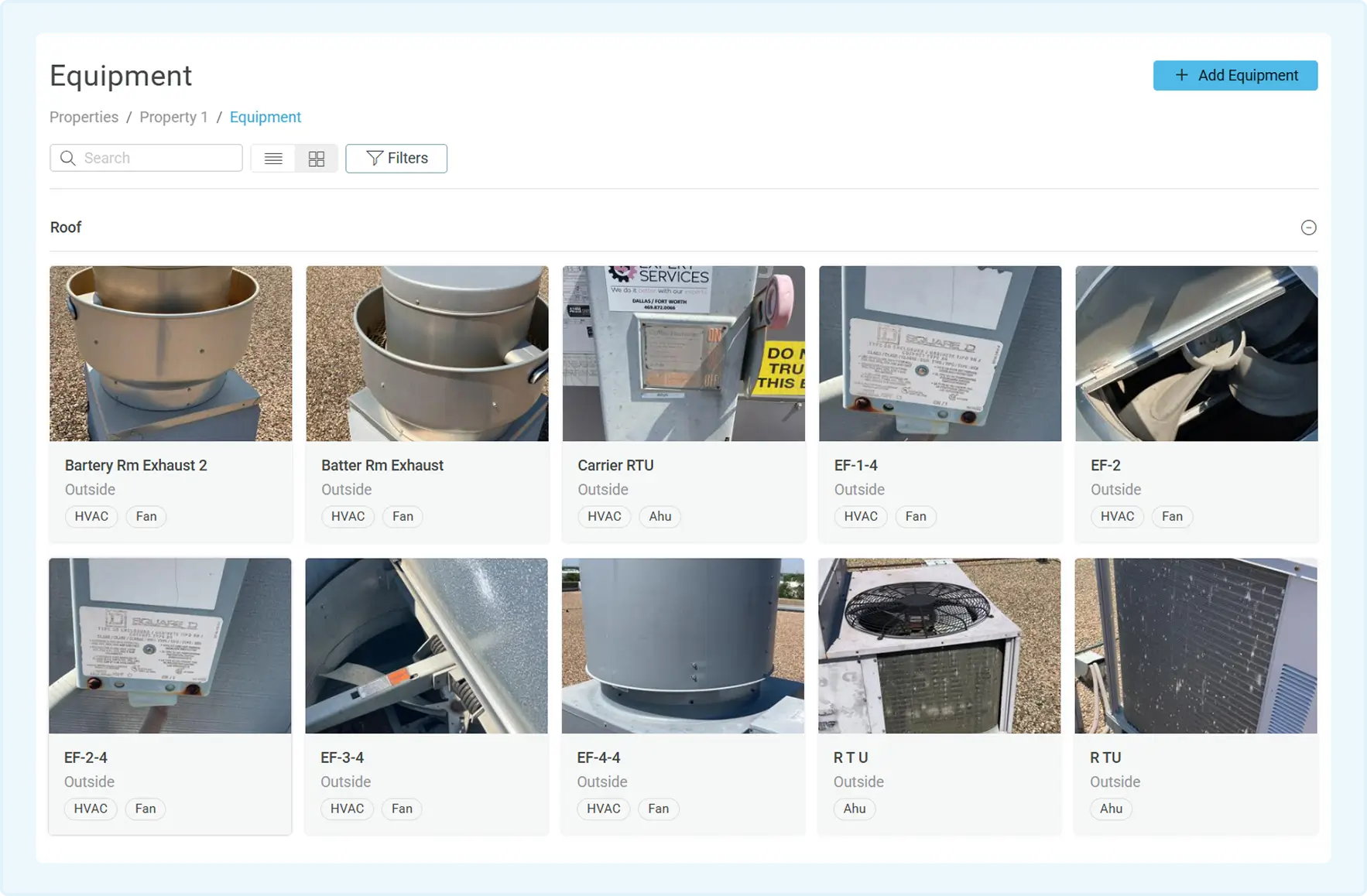
Digitization: Building a Digital Equipment Inventory
For this deployment, the selected data capture approach included on-site installation of devices and QR codes, so Enertiv began with a physical site survey.
Each asset was photographed, QR-tagged, and documented with details such as manufacturer, serial number, manuals, and operating condition. That gave the landlord a reliable digital record of what was actually installed at each property.
That site-level inventory created value beyond the deployment itself:
- Fewer deployment delays caused by undocumented site conditions
- A digital record of equipment and infrastructure available to asset and property teams
- Better equipment-level operational insights
- A stronger foundation for capital and decarbonization planning
- Visibility into site-level power capacity for future tenant needs
Turning Data Into Value
Once onboarding was complete and the systems went live, data began flowing into the platform automatically. The landlord gained a centralized portal with structured, accessible asset-level data, while each tenant received a dedicated interface to monitor their own consumption.
The impact went well beyond visibility. With the data in place, Enertiv identified $430K per year in savings and new revenue opportunities across nine tenants. These included energy conservation measures such as reducing operational load and managing peak demand, along with demand response programs where tenants are paid to reduce consumption during peak grid periods.
| Property | Number of Tenants | Insight Type | Total Value |
|---|---|---|---|
| Property 1 | 1 | Energy conservation measures. | $231,995/year |
| Property 2 | 3 | Energy conservation measures and demand response. | $152,708/year |
| Property 3 | 2 | Energy conservation measures. | $31,010/year |
| Property 4 | 2 | Energy conservation measures. | $12,416/year |
| Property 5 | 1 | Energy conservation measures. | $1,882/year |
| TOTAL | 9 | $430,011/yr |
These recommendations are generated by Enertiv's algorithms, validated by our engineering team, and delivered to tenants with estimated savings, environmental impact in CO2 avoided, and a ready-to-execute action plan.
Tenant Example
Element is one of the tenants included in this case study. At its site, energy use dropped 25%, delivering more than $50K in annual savings. The success of that work has since led to further expansion.
That story is documented in full here: Industrial Tenant Cuts Energy Use by 25%.
Beyond Data Capture
There is no single right way to capture tenant utility data. Shadow metering, QR-based manual reads, direct utility integrations all have a place, and which one fits depends on the lease structure, the electrical infrastructure, and the budget available. Part of the work is figuring out which combination makes sense for a given asset, which is what we did here.
But capture is where most of the market stops. The same data landlords collect for reporting can also show tenants where their energy dollars are going, and once the infrastructure is in place, putting that data to work requires very little additional cost. With energy costs rising and more tenants carrying public emissions commitments of their own, that conversation becomes more valuable every year, creating value on both sides of the landlord-tenant relationship.

$430K/yr
In savings and revenue opportunities identified
A real estate investment manager facing GRESB and UNPRI reporting deadlines, with persistent gaps in tenant-controlled utility data across its triple net portfolio.
Wherever you are on the journey, Enertiv is built to take you further.
For more than 15 years, we’ve helped owners & operators get the data they need, unlock asset value, maximize NOI, and accelerate decarbonization.