
Industrial Tenant Cuts Energy Use by 25% Through Efficiency Improvements
The industrial tenant operates testing, inspection, and certification facilities where work runs around the clock and a single cycle can stretch for weeks. That makes electricity one of the largest line items at any site, so anything that can cut consumption and waste is always at the top of the list.
The company also committed to a 50% emissions reduction by 2030 and Net Zero by 2050. Its sustainability leader had spent three years building the foundation those targets required: mapping the occupied real estate, consolidating it into a central inventory, and digitizing utility bills to establish a defensible emissions baseline.
That work was essential and surfaced several ideas for low-cost optimizations. At the time, however, the team was projecting much more modest reductions, around 5%, and the initiative was ultimately set aside.
Things changed at one of the company's facilities, where the landlord had partnered with Enertiv to solve a challenge common across NNN portfolios: collecting tenant consumption data. Enertiv installed shadow meters that captured consumption in 15-minute intervals. This made it possible to see where and when energy was being used and identify the improvements with the greatest potential impact.
Key Results
- 25% reduction in annual site electricity consumption
- $51,000/yr in energy cost savings through efficiency improvements and operational optimization
- Approximately 399,000 lbs of CO2 emissions avoided annually
- $84,971/yr in total value, split between operational savings and energy programs/incentives
The Initial Findings
As soon as the devices were installed, Enertiv surfaced the data to the industrial tenant through the Tenant Portal. For the first time, the sustainability team and the site team could watch consumption as it happened instead of reading about it on a bill at the end of the month.
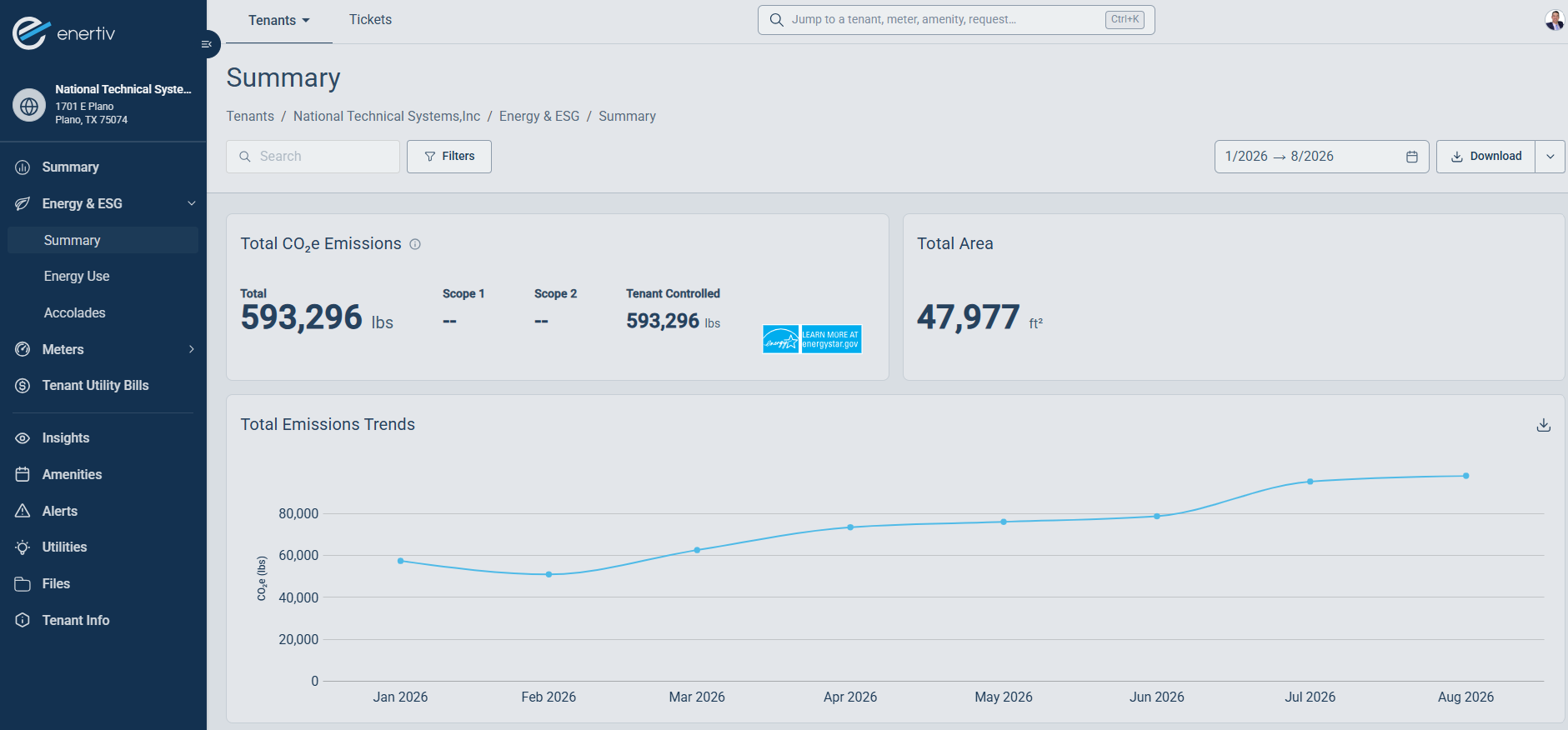
Site data was then analyzed by Enertiv's algorithms with direct support from the engineering team, which highlighted a number of opportunities related to heating, ventilation and air conditioning (HVAC) systems.
Working alongside the site team, Enertiv developed a plan that combined essential infrastructure upgrades with a series of targeted efficiency improvements.
Turning Insights Into Action
The plan introduced several low-cost operational improvements:
- HVAC controls were secured and scheduled to run with higher temperature set points outside normal business hours.
- Rooftop unit startup was staggered so equipment no longer ramped up simultaneously, cutting the demand peak that had been setting the monthly charge.
- Ventilation and HVAC runtime were matched to actual occupancy patterns instead of running as though every hour were fully occupied.
The site also took on two capital projects. An aging cooling tower nearing the end of its life was replaced with new high-efficiency chillers, which kept the site running reliably while cutting the energy required to cool it. And three 12-foot warehouse fans were installed to improve air circulation in the testing areas, allowing the HVAC systems to work less to hold the same conditions.
To make sure the findings actually got implemented, Enertiv's engineering team held monthly and biweekly review calls with the site team, tracking the impact of each measure closely and supporting the work from start to finish.
"I'm very impressed by this, genuinely. I want to take this and show it to my team."
Global Director of Environment and Sustainability
The Results
Beyond the operational efficiency measures and the equipment upgrade, Enertiv also used the site's data to identify opportunities in energy programs. Demand response pays site teams for reducing consumption during a handful of peak periods each year.
Here is a summary of the total impact through Q3 2026:
| Category | Description | Annual value | Status |
|---|---|---|---|
| Operational savings | Efficiency improvements and operational optimization already in place | $51,257 | Implemented |
| Additional operational insights | Further low-cost adjustments to how existing equipment runs | $22,740 | In progress with the site team |
| Demand response | Utility payments for curtailing load | $10,974 | In progress with Enertiv partners |
| Total | $84,971 |
Enertiv is now working with both the industrial tenant and the landlord on extra capital improvements, including building insulation and LED retrofits.
What It Means for an Industrial Tenant
The work at this site is a great example of how data and practical action can help an industrial tenant reach its sustainability goals. The initiative produced a pattern the company can repeat: start with where consumption stops matching operations, make the adjustments that cost nothing, then let the capital projects follow the evidence instead of leading it.
That pattern gets more valuable every year. Facilities today draw three to five times the power of a 2024-vintage baseline, and electricity prices have been climbing faster than inflation in most markets. As both curves move in the same direction, occupiers are increasingly looking for buildings that can support their decarbonization and sustainability commitments rather than simply house them.
Landlords who can hand a tenant the data, the analysis, and the engineering support to act on all of it are answering a question most of their competitors cannot.
"We've never received this kind of insight before. It's definitely interesting to have a landlord who wants to be on this journey with us."
Global Director of Environment and Sustainability

25%
Reduction in annual electricity consumption
A global testing, inspection, and certification company running around-the-clock operations across more than 270 facilities worldwide.
Wherever you are on the journey, Enertiv is built to take you further.
For more than 15 years, we’ve helped owners & operators get the data they need, unlock asset value, maximize NOI, and accelerate decarbonization.